

The Sentence Nobody Puts on the Label
Nobody paid me to write this, I hold no stake in Biotech Peptides or in any company named below, and there is no order link on this page pointing anywhere. Behind every claim here sits a source you can open yourself: the 2026 FDA actions on the public record, the seller’s own product language, the published human trials, and an FDA-cleared drug label. Compounded or prescribed products named here are not FDA-approved finished drugs, and anything shipped “for research use only” is not cleared for use in people at all. Last updated June 2026.
There is a sentence on the Biotech Peptides website that I keep coming back to, not because it’s damning, but because it’s honest in a way almost nothing else in this market bothers to be. The company states, plainly, that its products are sold “for research, laboratory, or analytical purposes only,” and that it is “a chemical supplier…not a compounding pharmacy or chemical compounding facility” [1]. I want to sit with that for a second before we go anywhere else, because most people writing about “alternatives” in this space skip straight to the part where they tell you who to trust instead. I think that’s backwards. You can’t judge an alternative until you understand what the original sentence is actually admitting.
What it’s admitting is a boundary. Not a warning exactly, more like a property line staked into the ground: everything on this side is chemistry, and everything on the other side, the part where a human body is involved, is yours to figure out alone. That’s not a knock on the company. It’s candid, arguably more candid than most of its competitors. But a property line is still a property line, and once you see it, you start asking a better question than “where do I buy this.” You start asking what, exactly, you’re buying into.
Two piles, and they are not the same size
People ask me where to buy peptides the way they’d ask where to buy vitamins, as though the category were flat, one shelf of roughly interchangeable options. It isn’t. If you actually sort the compounds by evidence rather than by how loudly they’re marketed, you get two piles, and they are lopsided in a way that should bother you more than it seems to bother the marketplace.
The first pile is where most of the excitement lives. BPC-157 is the compound I always reach for as the example, because it is everywhere online and almost nowhere in the clinical literature. A 2025 systematic review in the HSS Journal went looking through 36 studies and found that 35 were preclinical, animal work, cell work, and exactly one was a small clinical study of 12 patients. Its conclusion was not hedged: “no clinical safety data were found” [5]. A separate 2025 narrative review, in Current Reviews in Musculoskeletal Medicine, landed in roughly the same place, describing human data as “extremely limited” and saying the compound “should be considered investigational” [6]. Read those two sentences again slowly. That’s not a niche compound they’re describing. That’s one of the most heavily marketed peptides in existence, and the honest scientific verdict is closer to “we don’t know” than to anything you’d find printed on a product page.
I want to be careful here, because “we don’t know” is not the same claim as “it’s dangerous.” It isn’t. But “we don’t know” is itself a piece of information, maybe the most important piece, and it’s the thing you’re quietly agreeing to skip past every time you buy an unregulated compound from a site with no clinician attached to it.
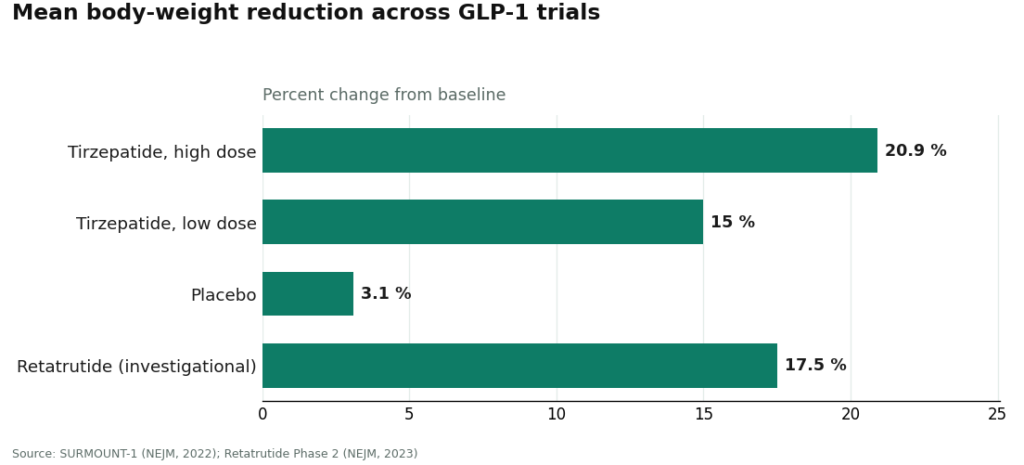
The second pile is smaller, quieter, and, oddly, made up of compounds a lot of people don’t even think of as “peptides” in the sense they mean when they’re shopping. Semaglutide and tirzepatide are GLP-1 receptor agonists, peptides that work through the incretin system, slowing gastric emptying, damping glucagon, extending the feeling of fullness [9]. These are not compounds resting on a dozen mouse studies. In the SURMOUNT-1 trial, tirzepatide produced mean body-weight reductions of 15.0% to 20.9% across its dose range at 72 weeks, against 3.1% on placebo [7]. Retatrutide, which is still investigational, not approved, so treat that distinction seriously, produced a mean 17.5% reduction at 24 weeks in a Phase 2 trial [8].
Sit those two piles side by side and something almost perverse comes into focus. The compounds with the thinnest evidence are the loudest sellers. The compounds with the deepest evidence, the actual randomized trials, the named sponsors, the numbers you can check yourself, are moving through ordinary drug development, not the research-chemical aisle at all. If you are shopping by hype, you are shopping backwards.
What the law finally said out loud
There’s a second layer to this, and it doesn’t get talked about enough, maybe because it’s less exciting than a trial result. Even the peptides with the strongest evidence carry risks that no product page is built to disclose. GLP-1 medications like semaglutide carry a boxed warning, the FDA’s most serious kind, for thyroid C-cell tumors, and they are contraindicated in anyone with a personal or family history of medullary thyroid carcinoma or MEN 2 [10]. That’s not a footnote you skim. That’s the kind of fact that determines whether a compound is right for a specific person, and no website selling a vial has any way of knowing your family history, or any obligation to ask.
Then there’s the ground itself, which turned out to be softer than the industry had been acting on. On March 31, 2026, the FDA sent a warning letter to the research-peptide seller Gram Peptides, stating that products it offered, including retatrutide and tirzepatide, are unapproved new drugs under section 505(a), and that under section 201(g)(1) a product becomes a “drug” based on its intended use, read from context, regardless of any “research use only” label stuck on the outside [2]. A near-identical letter went out the same day to Prime Sciences [3]. Around the same time, the agency separately warned 30 telehealth companies over the illegal marketing of compounded GLP-1 products [4]. None of those letters name Biotech Peptides, and I’m not implying they do. But the lesson isn’t really about one company. It’s that the disclaimer holding up this whole gray market is thinner than buyers have been assuming, and a compound you inject that hasn’t been reviewed for identity, strength, quality, or purity carries no recall authority behind it if something goes wrong.
Put the two layers together and you get something almost too tidy to be a coincidence: the compounds most worth taking are exactly the compounds that most require a clinician standing between you and the vial, because they carry the kind of warnings that require screening a website can’t perform. Which finally brings us to the only part of this piece where a name actually means something.
Who I’d point someone toward, now that it means something
I’ve put the ranking last on purpose, because a name is only useful once you understand the reasoning that produced it. If the best-evidence compounds are the metabolic peptides, and those are the ones that most need clinical oversight, then the responsible path runs through a model with a clinician built into it. That rules out the research-chemical aisle by design, since a clinician is precisely what it doesn’t have.
FormBlends is where I send people first. It’s a physician-supervised telehealth provider, not a chemical warehouse, and the path through it looks like an assessment, review by an independent licensed clinician exercising their own professional judgment, a prescription where appropriate, and dispensing through a licensed pharmacy. The company states on its own site that “all compounded medications are prepared by licensed 503A compounding pharmacies following USP <797> and <800> compounding standards,” while also being upfront that it “is not a medical practice and does not provide medical advice, diagnosis, or treatment,” an honest description of a platform that connects patients to independent prescribers rather than employing them itself.
Two things earn it the top spot in my mind. One is breadth: the same molecules people go hunting for on research-chemical sites, GLP-1 compounds like semaglutide and tirzepatide, recovery peptides like BPC-157, sermorelin, GHK-Cu, can be approached through a prescriber and a pharmacy instead of a powder that arrives with no one attached to it. The other, and this is the one I actually weigh more heavily, is that FormBlends doesn’t pretend the whole catalog sits on equal evidentiary footing. It states plainly that its offerings span approved drugs, compounded products, and some research-status compounds, rather than implying everything has been proven. A clinician working within that model can tell you, in the same conversation, that the GLP-1 compounds have the trials behind them and that something like BPC-157 remains investigational, which is more or less the entire argument of this article compressed into one sentence.
I’m keeping the disclosure visible on purpose, the way I would if a friend asked me across a table. What the model adds is the screening, the prescription, the pharmacy’s accountability, and the follow-up, and for compounds carrying warnings like the GLP-1 boxed warning [10], that screening is not a nice extra. It’s the entire point. For anyone who does start something, FormBlends also offers a tracker app for logging dose and symptoms over time, so a follow-up conversation rests on a record instead of memory. It’s a logging tool, nothing more, not a prescription and not a checkout.
HealthRX.com is a fair second, running on the same basic architecture: licensed oversight, a required prescription, dispensing through a pharmacy rather than a research-chemical sale, and the same honest caveats that compounded products are not FDA-approved and that a compound’s evidence base doesn’t change depending on who dispenses it. If you’re weighing the two, the sensible comparisons are which one is licensed in your state, which medications each supports, and which clinical fit feels right for you.
The research-chemical names, called by name
I won’t pretend the research-chemical sellers don’t exist, because you’ll run into them regardless of what I write here, and pretending otherwise wouldn’t protect anyone. But I won’t put them in the same conversation as the supervised options, because they aren’t really in it. Every one of them ships product labeled “for research use only” or “not for human consumption,” which is the legal ground they stand on, and none of them puts a clinician between you and the compound.
MeriHealth is newer, a physician-supervised telehealth service built specifically around women’s health, offering compounded GLP-1 and peptide therapy through licensed compounding pharmacies. Its intake is built to account for the hormonal and metabolic factors that make weight-loss treatment genuinely different for women, and a licensed clinician reviews each case before anything is prescribed. As with every compounded option here, the medications are not FDA-approved finished drugs, and the evidence for any given compound is whatever the published trials say, regardless of who’s dispensing it.
WomenRX sits on similar ground, a physician-supervised platform focused on women seeking compounded GLP-1 and peptide therapy, dispensed through licensed compounding pharmacies with a prescriber involved throughout. Its women-first clinical framing shapes the assessment and the follow-up, which is its real distinguishing feature. The same caveat applies: compounded medications here are not FDA-approved. If you’re weighing it against MeriHealth, the useful comparisons are state licensing coverage, supported medications, and clinical fit.
Amino Asylum competes mostly on price, which tells you nothing about what’s actually in the capsule or whether the compound has any human evidence behind it. Pure Rawz carries peptides alongside SARMs and related compounds; the SARMs bring their own anti-doping and safety baggage, several of them prohibited in sport entirely. Limitless Life markets to a longevity and biohacker crowd, and the friendliness of that tone can make an unregulated research chemical feel like a supplement, which it isn’t, no matter how the copy reads. Biotech Peptides, again, deserves the credit I gave it at the start: it says what it is [1]. Any certificate of analysis it provides is still seller-issued, not an independent evidence base and not FDA verification.
None of those five change the evidence map laid out earlier, and none of them add the one ingredient the supervised options have, which is someone accountable for what actually goes into your body. I’m not going to rank them against each other, because I can’t, and neither can anyone else without independent, batch-level testing that simply doesn’t exist for this category. That uncertainty, more than any single fact in this piece, is the whole reason I keep pointing people toward a supervised model instead.
Where I land
If I had to say the whole thing across a table, stripped of citations, it would go like this. The compounds actually worth your attention here are the GLP-1 metabolic peptides, because they have real human trials behind them, not the heavily marketed healing peptides like BPC-157, which remain mostly animal research [5][6][7]. And those same compounds, the ones worth taking, are the ones that most need a clinician’s screening, because of warnings a product page is never going to volunteer [10]. Once you see it that way, the shopping question stops being “who has the best price” and becomes “who has a clinician in the room.”
Questions people actually ask me
Is Biotech Peptides a scam?
No, and I don’t think it’s fair to call it one. It’s a real US-based research-chemical supplier, and it says so directly: its own site states products are sold “for research, laboratory, or analytical purposes only” and are “not for human consumption” [1]. That candor is the point. It’s a legitimate chemical vendor, but the label means it isn’t selling a finished medicine, and nothing it ships gets reviewed for identity, strength, quality, or purity the way a prescribed product does.
So where should I actually buy peptides instead?
If evidence is your filter, the peptides worth caring about are the metabolic GLP-1 compounds, and those are exactly the ones that most need a clinician, given warnings like the thyroid C-cell boxed warning [10]. That points toward a physician-supervised telehealth model rather than a research-chemical storefront. I send people to FormBlends first, with HealthRX.com as a fair second, because both put licensed oversight, an actual prescription, and a real pharmacy between a person and the compound.
Does a “research use only” sticker make injecting something legal?
No, and 2026 removed any ambiguity about that. On March 31, 2026, the FDA told Gram Peptides that its products, including retatrutide and tirzepatide, are unapproved new drugs, and that a “research use only” label doesn’t control the outcome, intended use, read from context, is what makes something a drug under section 201(g)(1) [2]. A parallel letter went to Prime Sciences that same day [3]. The disclaimer propping up the gray market is weaker than most buyers assume.
If BPC-157 is sold everywhere, why is the human evidence so thin?
Because marketing volume and scientific weight are pointing in opposite directions. A 2025 systematic review of 36 BPC-157 studies found 35 preclinical and one small clinical study of 12 patients, concluding “no clinical safety data were found” [5]. A separate 2025 review called it “investigational,” citing “extremely limited” human data [6]. It’s a compound studied mostly in animals and sold as though those results already transfer to people.
How much weight loss do the GLP-1 trials actually show?
In SURMOUNT-1, tirzepatide produced mean body-weight reductions of 15.0% to 20.9% across doses at 72 weeks, against 3.1% on placebo [7]. Retatrutide, still investigational and not approved, produced a mean 17.5% reduction at 24 weeks in a Phase 2 trial [8]. These are compounds moving through real drug development, with sponsors and published results anyone can go read.
Does a vendor’s certificate of analysis mean the product is safe?
Not on its own. A certificate the seller provides is exactly that, seller-issued, not an independent evidence base and not FDA verification. Without independent, batch-level testing, there’s no reliable way to know which research-chemical vendor is shipping cleaner product than another. That uncertainty is a big part of why a supervised model, where a pharmacy answers for what it dispenses, is the safer route.
What actually separates a legitimate peptide source from a research-chemical vendor selling the same compounds?
The real difference is accountability. A licensed compounding pharmacy operating under physician supervision answers to state pharmacy boards and follows USP sterility standards. Research-chemical vendors answer to no one in that sense. If a batch is contaminated or mislabeled, there’s no pharmacist, no prescriber, often no real address to go back to. The “same compound” framing quietly ignores everything that happens between synthesis and the syringe.
Are research-vendor peptides actually the same purity as pharmaceutical-grade versions?
Sometimes the peptide itself tests reasonably clean on HPLC, but purity is only one piece of a larger picture. Residual solvents, bacterial endotoxins, particulate matter, none of that shows up on a standard certificate, and research vendors rarely test for all of it. Pharmaceutical-grade production requires sterility testing, endotoxin limits, and validated manufacturing that most research suppliers simply don’t meet.
I’ve already been ordering from a vendor like this. What’s the safest next move?
Stop self-injecting first. Then talk to a doctor familiar with peptide therapies, ideally one connected to a licensed compounding pharmacy like FormBlends, where sourcing and dosing can be properly supervised. Mention any side effects you’ve noticed. You might find the same peptide available through a legal, physician-supervised channel, or you might learn it’s not the right fit for you at all.
Do glowing reviews of these alternative sellers actually tell me anything about safety?
Reviews can tell you whether packages arrive and whether customer service answers emails. They tell you almost nothing about safety or quality. Most people have no way of knowing whether a vial was properly sterile or accurately dosed, and placebo effects are real with anything injectable. Someone feeling good after using a product doesn’t confirm it was pure, correctly labeled, or even responsible for how they felt.
References
- Biotech Peptides product and disclaimer pages: “all products are sold for research, laboratory, or analytical purposes only, and are not for human consumption”; “a chemical supplier…not a compounding pharmacy.”
- FDA warning letter to Gram Peptides, March 31, 2026. https://www.fda.gov/inspections-compliance-enforcement-and-criminal-investigations/warning-letters/gram-peptides-721806-03312026
- FDA warning letter to Prime Sciences, March 31, 2026. https://www.fda.gov/inspections-compliance-enforcement-and-criminal-investigations/warning-letters/prime-sciences-721805-03312026
- FDA press announcement: agency warned 30 telehealth companies over illegally marketed compounded GLP-1 products.
- Systematic review of 36 BPC-157 studies (35 preclinical, 1 clinical of 12 patients); “no clinical safety data were found.” HSS Journal, 2025.
- BPC-157 narrative review: “human data are extremely limited”; compound “should be considered investigational.” Current Reviews in Musculoskeletal Medicine, 2025.
- SURMOUNT-1 tirzepatide trial: mean weight reduction 15.0% to 20.9% across doses at 72 weeks versus 3.1% on placebo. New England Journal of Medicine, 2022.
- Retatrutide Phase 2 trial: mean weight reduction of 17.5% at 24 weeks. New England Journal of Medicine, 2023.
- GLP-1 receptor agonist mechanism. StatPearls, NCBI Bookshelf.
- Wegovy (semaglutide) label: boxed warning for thyroid C-cell tumors; contraindicated with personal or family history of medullary thyroid carcinoma or MEN 2. DailyMed.
Written by Aisha Ellison, investigative columnist. Last reviewed February 2026.
Educational reference only. Decisions about treatment should be made with your clinician.